
blog
How to Partner with a Premium Crossbody Bag Manufacturer for Your Brand

Sep
The crossbody bag has evolved from a simple utilitarian accessory into an absolute streetwear and high-fashion staple. For emerging designers and established retail labels alike, capitalizing on this consumer demand requires more than just a brilliant design concept—it requires an exceptional production partner. Choosing the right crossbody bag manufacturer dictates your product’s durability, aesthetic finish, and ultimately, your brand’s reputation in a fiercely competitive retail landscape.
Finding a factory that aligns with your brand values, quality standards, and scaling timeline is a strategic process. When sourcing a wholesale partner for your next accessory line, several technical and operational factors must be rigorously evaluated.
Essential Capabilities of a Top-Tier Production Partner
Not all production facilities are equipped to handle the specific structural requirements of crossbody designs. When vetting a potential crossbody bag manufacturer, you must first establish their core production capabilities and their approach to custom fabrication.
- OEM vs. ODM Services: Determine if you need Original Equipment Manufacturing (OEM), where the factory produces your exact proprietary design, or Original Design Manufacturing (ODM), where you customize pre-existing templates designed by the factory. A versatile partner will offer both, providing flexibility as your brand expands.
- Dedicated Sample Rooms: The transition from a two-dimensional tech pack to a physical product requires specialized skill. Look for a facility with an in-house sample room staffed by veteran pattern makers who can refine the ergonomics and drape of the bag before bulk production begins.
- Comprehensive Sourcing Networks: A manufacturer is only as strong as its supply chain. Your partner should have established relationships with premium fabric mills and hardware suppliers, ensuring you have access to the latest textile innovations and durable components.

Material Selection: The Foundation of Durability
Crossbody bags experience high friction, as they constantly rub against the wearer’s clothing. They also bear concentrated weight on a single strap. Therefore, the materials utilized must balance aesthetic appeal with extreme abrasion resistance. A knowledgeable manufacturer will guide you toward textiles that fit your specific use case.
| Material Type | Ideal Use Case | Key Characteristics |
| High-Denier Nylon | Urban streetwear, activewear, travel | Highly water-resistant, lightweight, exceptional tear strength, easily wipeable. |
| Vegan Leather (PU/Microfiber) | Contemporary fashion, everyday luxury | Cruelty-free, offers a premium structured look, requires specialized edge-painting techniques. |
| Heavyweight Canvas | Heritage brands, casual day-use | Breathable, easily customizable with screen printing, develops a unique patina over time. |
| Recycled Synthetics (RPET) | Eco-conscious brands, outdoor gear | Spun from post-consumer plastics, highly durable, significantly lowers carbon footprint. |
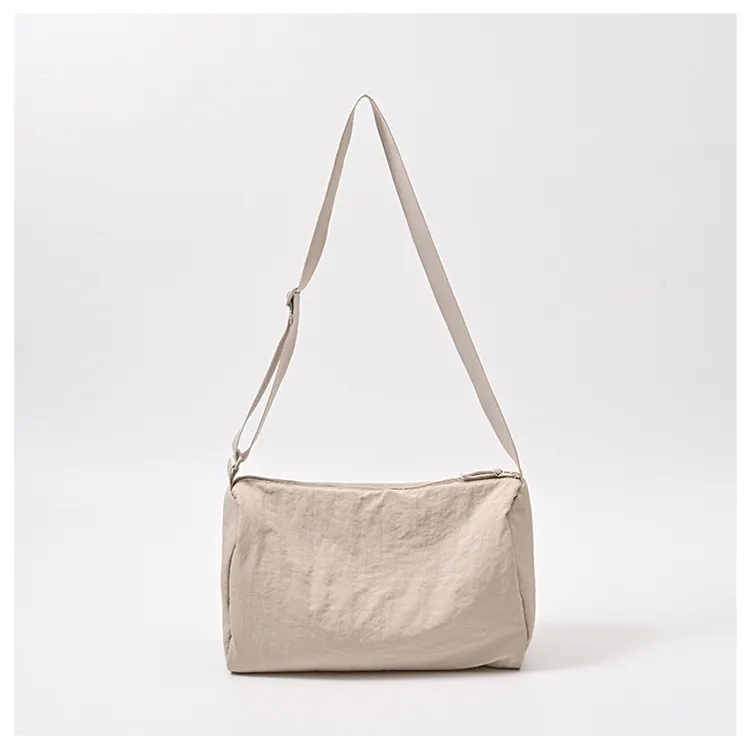
The Critical Role of Hardware and Strap Construction
The defining feature of a crossbody bag is, naturally, the strap. This makes the hardware and attachment points the most vulnerable areas for potential failure. A premium manufacturer will prioritize heavy-duty construction techniques in these specific zones.
When discussing specifications with your supplier, mandate the use of bartack stitching at all stress points where the strap connects to the main body. Furthermore, the hardware itself—D-rings, swivel snap hooks, slide adjusters, and zippers—must be commercial-grade. Opting for industry-standard components, such as YKK zippers and alloy buckles, prevents frustrating jams and breaks. The manufacturer should offer various hardware finishes, from matte black powder coating to brushed brass, allowing you to perfectly match the metalwork to your brand’s visual identity.
Navigating Minimum Order Quantities (MOQs)
One of the most significant hurdles for growing brands is managing inventory investment. Minimum Order Quantities (MOQs) dictate the smallest production run a factory is willing to execute. While large overseas facilities might demand thousands of units per colorway, a strategic manufacturing partner understands the need for manageable scale.
Look for a supplier that offers flexible MOQs. This flexibility allows you to test new silhouettes and seasonal colorways in the market without overcommitting your working capital. As your brand gains traction and sales volume increases, that same manufacturer should have the infrastructure and workforce to seamlessly scale your production runs from hundreds to tens of thousands of units without compromising on lead times or stitch quality.
Rigorous Quality Control Standards
The final step in the manufacturing pipeline is arguably the most important. A beautiful design is worthless if it arrives at your warehouse with frayed seams, misaligned logos, or faulty closures.
Inquire deeply into the factory’s Quality Assurance (QA) protocols. A reliable crossbody bag manufacturer will implement inline inspections during the cutting and sewing phases, rather than just waiting until the bags are finished. This proactive approach catches tension issues or material flaws immediately. Final inspections should include rigorous stress-testing of the straps, zipper functionality checks, and verification that all custom branding—whether debossed, embroidered, or woven—is perfectly centered and legible.
Establishing a partnership with a manufacturer that treats your product with this level of meticulous care guarantees that your customers receive an accessory built to withstand the rigors of daily wear.
